
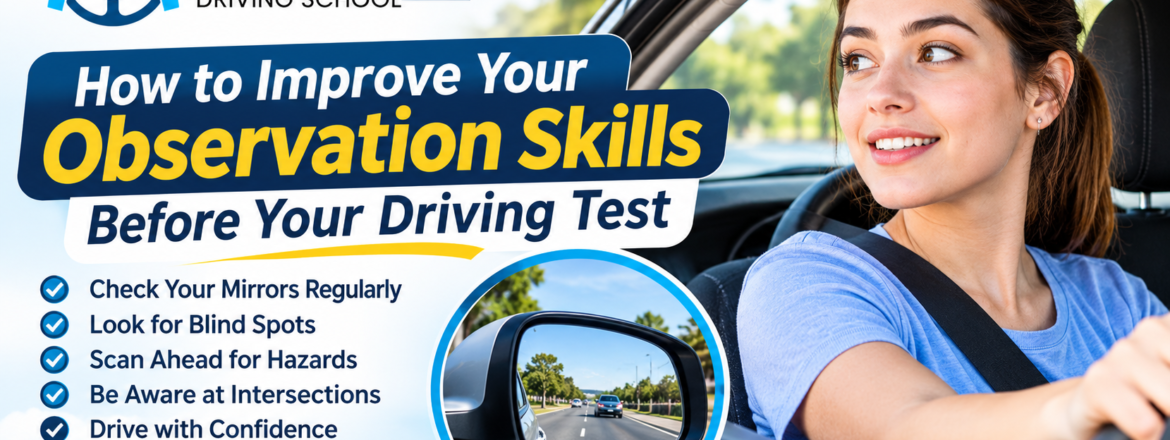
Preparing for your Practical Driving Assessment (PDA) in Perth involves more than learning how to steer, accelerate, brake and park. Strong observation skills are essential for identifying hazards, understanding traffic conditions and making safe driving decisions. Developing these skills before your test can help you become a more confident and responsible driver.
Thank you for reading this post, don't forget to subscribe!At Brilliant Driving School, learners receive practical driving instruction designed to improve road awareness, observation and decision-making. Whether you are a beginner, preparing for your PDA, or looking to improve your driving confidence, regular practice with a qualified instructor can help you develop safer driving habits.
Why are Observation Skills Important for Your Driving Test?
Observation skills help you understand what is happening around your vehicle. During your driving test, you need to demonstrate that you can identify potential hazards, check for other road users and respond appropriately to changing road conditions.
Good observation includes:
- Checking mirrors regularly and before changing speed or direction.
- Looking over your shoulder when necessary to check blind spots.
- Scanning intersections for vehicles, pedestrians and cyclists.
- Observing traffic signs, road markings and speed limits.
- Identifying hazards early and adjusting your driving safely.
- Checking for potential risks before reversing, parking, or changing lanes.
Practising these habits during every lesson helps make them a natural part of your driving routine.
Read Also – How to Get Learners Permit WA
1. Develop a Regular Mirror-Checking Routine
Your mirrors help you understand what is happening behind and beside your vehicle. Check them regularly, especially before slowing down, braking, changing lanes, turning, or moving away from the kerb.
Remember these tips:
- Check your rear-view and side mirrors regularly.
- Check your mirrors before signalling or changing position.
- Recheck the traffic around you before completing a manoeuvre.
- Avoid staring at mirrors for too long; keep your attention on the road ahead.
Your observations should be appropriate to the situation. Mirror checks are important, but you must also look ahead and remain aware of pedestrians, cyclists and other vehicles.
2. Always Check Your Blind Spots
Blind spots are areas around your vehicle that cannot be seen clearly in your mirrors. Before moving off from the kerb or changing lanes, check your mirrors and perform a shoulder check where appropriate.
Practise this routine during lessons until it becomes consistent. Pay particular attention to cyclists, motorcyclists and vehicles travelling beside you.
A car driving school Perth learners choose should help them understand when blind-spot checks are needed and how to perform them safely without losing awareness of the road ahead.
3. Look Well Ahead Instead of Focusing Only on the Car in Front
Looking far enough ahead gives you more time to recognise hazards and plan your next action. Avoid concentrating only on the vehicle directly in front of you.
During practice, scan the road ahead for:
- Traffic lights and changing signals.
- Pedestrians approaching crossings.
- Vehicles waiting to enter traffic.
- Roundabouts, intersections and road signs.
- Parked vehicles that may pull out.
- Children, cyclists and other vulnerable road users.
Early observation allows you to adjust your speed smoothly and maintain a safe following distance.
4. Improve Your Observation at Intersections
Intersections require careful observation because traffic can approach from several directions. Before entering an intersection, check the relevant traffic signals, road signs, markings and surrounding road users.
When approaching a junction:
- Reduce speed when appropriate and prepare to stop if required.
- Observe the traffic lights, signs and road markings.
- Check for vehicles, cyclists and pedestrians.
- Look in the appropriate directions before proceeding.
- Enter only when it is safe and lawful to do so.
Never assume another road user will stop or give way. Continue observing as you approach and move through the intersection.
5. Practise Safe Observation at Roundabouts
Roundabouts require you to assess traffic approaching from different directions. As you approach, observe the signs and lane markings, select the correct lane and give way as required.
During your lesson, practise identifying safe gaps, checking mirrors before changing speed or position and observing pedestrians and cyclists nearby. Signal appropriately and maintain awareness of other vehicles as you enter, travel through and exit the roundabout.
Consistent practice can make roundabouts easier to manage during your PDA.
6. Use Observation Skills While Parking and Reversing
Parking and reversing require you to monitor the area around your vehicle continuously. Before beginning, check for pedestrians, vehicles, obstacles and other potential hazards.
To improve your technique:
- Check mirrors and blind spots before moving.
- Look around the vehicle rather than relying on one mirror.
- Reverse slowly and maintain control of the vehicle.
- Stop if your view is obstructed or a hazard appears.
- Check the surrounding area again before moving forward.
Practise parallel parking, angle parking and reversing with your instructor so you can apply safe observation habits consistently.
7. Identify Hazards Early and Plan Your Response
Hazard perception means recognising something that could create a risk and deciding how to respond safely. A parked car may conceal a pedestrian, a vehicle ahead may brake suddenly, or a cyclist may move into your path.
Ask yourself these questions while driving:
- What could happen next?
- Is anyone approaching or entering my path?
- Do I need to reduce speed or increase following distance?
- Is there a safe space to stop if necessary?
- Have I checked my surroundings before acting?
The goal is not to predict every event perfectly. It is to notice developing risks early and make safe, appropriate decisions.
8. Practise With the Best Driving Lesson Perth Can Offer You
Choosing the best driving lesson Perth has to offer for your needs means looking for instruction that builds practical skills, confidence and safe driving habits. A useful lesson should include more than vehicle control; it should help you understand what to observe, when to check and how to respond to hazards.
At Brilliant Driving School, learners can practise everyday driving situations and prepare for their PDA with personalised instruction. Lessons can focus on intersections, lane changes, roundabouts, parking, reversing and other areas where observation is particularly important.
When looking for the best instructor Perth has for your learning needs, consider instructor experience, clear feedback, patience and the ability to explain mistakes constructively.
9. Consider Learning With a Female Driving Instructor in Perth
Some learners feel more comfortable learning with a particular instructor. If you prefer a female instructor, Brilliant Driving School offers access to both male and female instructors, subject to availability.
A female instructor Perth learners choose should provide clear guidance, practical demonstrations, and constructive feedback. The most important factors are finding an instructor who understands your learning needs and helps you develop safe, independent driving skills.
Discuss your goals before the lesson so your instructor can focus on the observation techniques you need to improve.
10. Follow a Simple Observation Practice Checklist
Use this checklist during your lessons and supervised practice:
- Check mirrors regularly and before changing speed or direction.
- Check blind spots before moving off or changing lanes when required.
- Scan ahead for traffic lights, signs, road markings, and hazards.
- Observe pedestrians and cyclists near crossings and intersections.
- Assess traffic carefully before entering roundabouts.
- Maintain a safe following distance.
- Check all around the vehicle before parking or reversing.
- Follow your instructor’s feedback and correct repeated mistakes.
Practise consistently rather than trying to master every skill in one session. Ask your instructor to identify the observation habits that need the most improvement and review your progress regularly.
Prepare for Your PDA With Brilliant Driving School
Improving observation skills takes time, repetition and feedback. By checking mirrors consistently, monitoring blind spots, looking ahead and identifying hazards early, you can build the awareness needed for safer driving.
Brilliant Driving School provides personalised driving lessons in Perth for learners who want to improve their road awareness, practise essential manoeuvres and prepare for their Practical Driving Assessment.
Whether you are looking for a car driving school Perth, the best driving lesson Perth for your needs, or a female instructor Perth, choose lessons that support your goals and help you become a safer driver.
Ready to improve your driving skills?
Visit Brilliant Driving School to explore available courses and book a lesson.
Phone: 0430 344 687 or 0432 577 842
Website: https://brilliantdrivingschool.com.au/
